
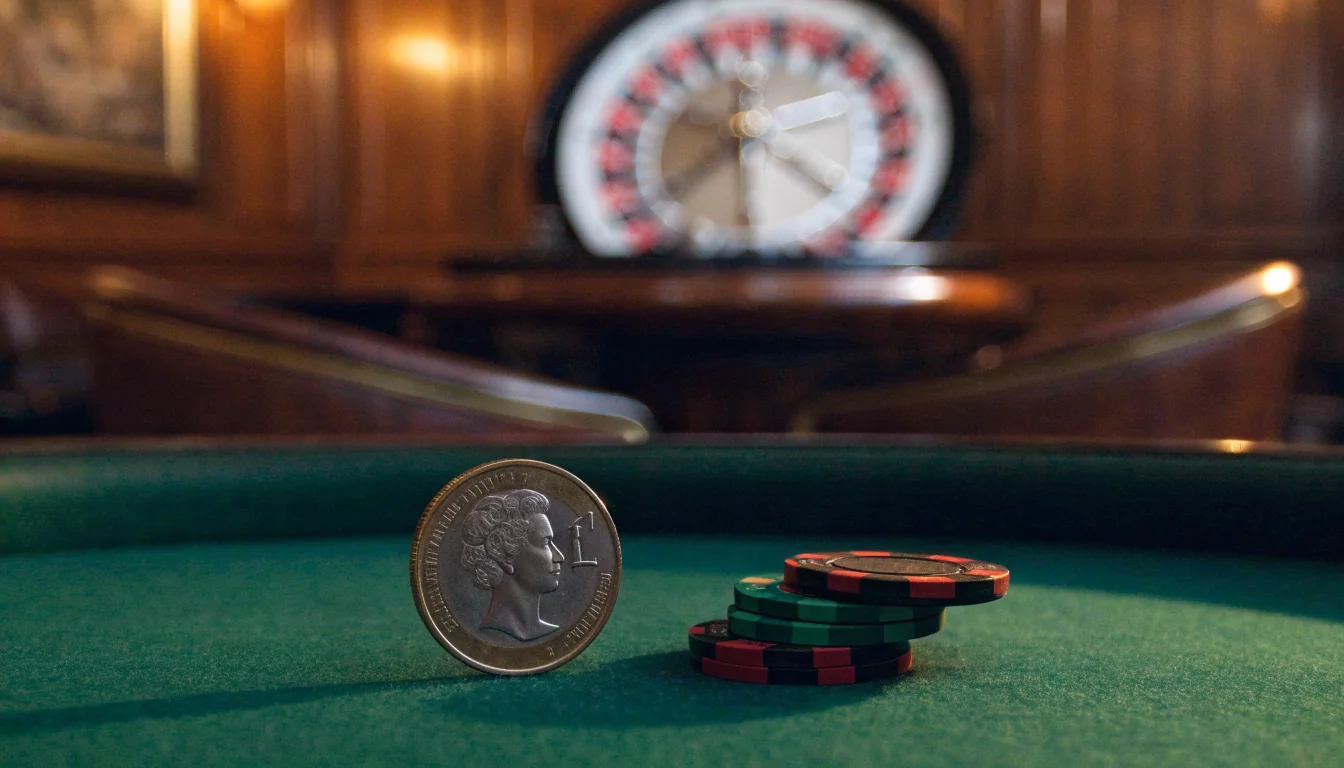
A low cashier minimum can limit your initial deposit, but it does not determine which promotions or withdrawals are available.
What a £1 Minimum Deposit Actually Gets You
A £1 minimum deposit means that, at a qualifying casino, you can put a pound into your account and have it recorded as a real-money balance. It describes the smallest amount the cashier will accept for that transaction. It does not mean that every UK casino accepts £1, or that a site advertising a small minimum will apply it to every account or circumstance.
The distinction is simple but useful: the cashier minimum is an entry condition for funding an account, not a description of everything you can do with the money afterwards. If the cashier accepts your pound, it becomes available as account funds under that operator’s rules. Whether you can access a promotion, make a particular kind of payment, or withdraw a balance is a separate matter governed by separate terms. A small number on the deposit screen answers one question only.
That makes a £1 option most valuable when your priority is to limit the amount you commit at the point of depositing. It can let you test the account process with a small sum rather than putting in more than you intended. But the amount should still be treated as money at risk, not as a free trial or a promise of a return. Casino play can use up a balance, and depositing a small amount does not change that basic fact.
There is also a difference between a casino accepting a £1 deposit in principle and your being able to complete one. A site can have a low cashier minimum while the particular route you choose has its own rules. The amount shown at the cashier is therefore the practical check: review the available options and the amount displayed before confirming. A headline elsewhere is not a substitute for the terms presented when you pay in.
For a UK player, the operator’s status matters as well as its cashier settings. Real-money online casinos serving the British market must hold the relevant UK Gambling Commission operating licence. A low deposit threshold does not establish that status; it is a payment condition, not a regulatory credential. Check that the operator is licensed before creating an account or depositing. The UK Gambling Commission is the regulator responsible for licensing remote gambling operators serving Great Britain.
£10 Minimum Deposit Casinos in the UK: How They Work
You must be at least 18 to gamble online in the UK. Operators must verify a customer’s age before allowing deposits, so a low minimum does not bypass account checks. Before your first deposit, set a financial limit you can afford to lose. That is a practical starting point, not paperwork to rush through because the amount seems modest. A pound remains part of your gambling budget.
The phrase “£1 minimum deposit” can also be misunderstood as a claim about the whole account experience. It is narrower than that. It says the operator may accept a deposit of that size; it does not say that every later transaction will be possible at the same amount, or that every feature is available to an account funded with a pound. Those details depend on the operator’s rules, and the cashier minimum alone cannot settle them.
Evidence about which sites accept a genuine £1 minimum can change as operators update their terms. One specialist review reported six UKGC-licensed casinos with that threshold in its assessment, but its snapshot should not be treated as a permanent market count. A separate claim about one operator being the only listed option is likewise tied to the review’s scope and timing. The useful takeaway is not a fixed league table: verify the current cashier minimum on the operator’s own site before opening an account.
Treat the pound as a way to fund an account, not as a shortcut to a particular outcome. If the deposit screen accepts it, you have met that screen’s minimum for the transaction. Nothing more is promised by the figure. Plain, but important.
Top online casinos in the UK
- WinBeastBonus: €5000 + 500 FS + €650 Freebet · Payout speed: 1-3 business days
- AmunbetBonus: Join now and get 450% up to 2,700 GBP + 450 FS · Payout speed: 1-3 business days
- ZombillionBonus: Welcome Pack 250% up to £4000 + 200 FS · Payout speed: 1-3 business days
- DieselwinBonus: Welcome Pack 250% up to £4000 + 200 FS · Payout speed: 1-3 business days
- NightWinBonus: £900 + 400 free spins · Payout speed: 1-3 business days
- SlotoSportBonus: 500% up to £ 10 200+ 777 FS · Payout speed: 1-3 business days
How Far a Pound Goes on the Slots
A £1 balance is easier to judge in spins than in headline terms. Many slot games let you stake between 10p and 20p on a spin. At the lower stake, your pound covers ten spins if each one costs 10p; at the higher stake, it covers five at 20p. Those are simple balance calculations, not a promise that a session will last that long: a win can change the balance, while losing spins reduce it.
At a 10p stake, a £1 balance covers ten spins; at a 20p stake, it covers five. Note that wins can increase the balance, while losses reduce it.
The stake you choose matters more than the size of the deposit once the money is in your account. A pound is not a fixed number of spins across every game, because games can offer different stake settings. Check the displayed cost before you start, and make sure it is the total cost for one spin rather than assuming that a selected coin value is the final stake. If the available setting costs more than your balance, that game is not suitable for a £1 session.
Think in stakes, not potential winnings
The useful comparison is the amount at risk each time you press spin. A smaller stake lets the balance cover more attempts; a larger one uses it more quickly. Neither changes the uncertainty of the outcome. A longer run of spins does not mean a win is due, and a single result cannot be treated as a reliable guide to what follows.
That is why “how many spins?” is only part of the decision. You also need to decide how much of the pound you are prepared to spend. If you stake 10p, each losing spin removes a smaller part of the balance than a 20p stake does. The difference is clear on paper. In play, it can be easy to overlook because the individual amounts are small.
A sensible way to approach a tiny balance is to regard it as a fixed entertainment cost, not money you expect to grow. Choose a stake you are comfortable losing, then stop when the balance is gone or when you have reached the limit you set. Do not raise the stake to try to recover losses. That changes the pace at which the balance is used; it does not turn a loss into a likely win.
What a pound cannot tell you
The deposit amount does not identify the game’s cost per spin. It also does not tell you what a game might return, how often it might pay, or how long a session will last. Those details cannot be inferred from the fact that a game accepts a small stake. Treat claims about a pound lasting a particular length of time with care: the outcome depends on the stake you select and the results of the spins.
The same distinction applies when comparing slots. For a £1 session, the practical criterion is whether the game offers a stake you can afford and whether its controls make that cost clear. A familiar title is not automatically a better fit for a small balance. Gates of Olympus and Mega Moolah can serve as examples of named slots to look up, but the titles alone do not establish their available stakes or how far a pound would go on them. Check the game screen rather than assuming every version or configuration is identical.
In Britain, online slot spins must take at least two and a half seconds, and autoplay is banned. So a theoretical count of spins is not a prediction of session duration, even before results are considered. You make each spin yourself, and the actual time also depends on how quickly you choose to continue.
Do
- Identify the cost of one spin
- Check that the cost fits your budget
- Calculate the maximum number of losing spins
Don’t
- Assume a familiar title is a better fit
- Rely on a forecast of winnings
- Ignore the total cost per spin
For comparing games, keep the test plain: identify the cost of one spin, check that it fits your budget, and work out how many spins the balance could cover if every spin lost. That last calculation is a ceiling on losing attempts, not a forecast. If a game offers several stake settings, compare them at the setting you would actually use. The lowest displayed stake is relevant only if you can select it and understand the full cost shown before play.
There is no universal “best” slot for a £1 balance. The better fit depends on your chosen stake: a lower cost per spin stretches the balance across more attempts, while a higher cost spends it sooner. Keep the distinction between a small deposit and a small stake in view. One is the amount added to the account; the other is what each spin takes from it.
Small balance. Clear stake.
The Catch: Withdrawals and Welcome Offers
A £1 cashier minimum tells you how little you can pay in, not how little you can take out. Those are separate rules. Before depositing, find the withdrawal minimum in the cashier information or account terms, and check whether it applies to each withdrawal request. A small balance can be available to play without being eligible to withdraw yet.
£2 Minimum Deposit Casinos in the UK: How They Compare
A specialist review reports withdrawal thresholds of £10 to £20 at many UK casinos. Treat that as a snapshot, not a promise about every operator: the rule for your account is the one the casino publishes and applies when you make a request. If the threshold is higher than your balance, you may have to leave the funds in the account until the balance meets it. That can mean continuing to play when your preference would be to stop. No bargain there.
Check whether the stated figure is a minimum withdrawal, a minimum cashout, or a condition attached to a particular balance. Those labels can appear in different parts of the terms, so read the wording rather than relying on a headline. Also look for any distinction between cash funds and promotional funds. A balance shown on screen does not, by itself, tell you whether all of it can be withdrawn.
The practical comparison is simple:
| What you are checking | What it tells you |
|---|---|
| £1 cashier minimum | Whether you can fund the account with £1 |
| Withdrawal threshold | Whether your available balance is large enough to request a payout |
| Promotion’s qualifying deposit | Whether your payment meets the offer’s entry condition |
A £1 minimum deposit casino may therefore suit you if the priority is testing a small real-money balance, while being a poor fit if you need to withdraw a very small amount. The deciding criterion is not the deposit figure alone; it is how that figure compares with the withdrawal rule. Read both before paying in.
A £1 deposit may not qualify for an offer
A welcome offer has its own qualifying deposit, which may be higher than the amount the cashier accepts. A specialist review reports qualifying deposit requirements of £5 to £10 for welcome offers. On that account, paying in £1 can put money into your account without triggering the promotion. The deposit has succeeded; the offer has not.
That difference matters because “minimum deposit” can refer to two separate thresholds. The cashier minimum is the least you can pay in. The promotional minimum is the least you must deposit to qualify for a particular deal, subject to its terms. One does not automatically override the other.
A welcome offer often has a qualifying deposit (such as £5 to £10) that is higher than the casino’s minimum deposit of £1.
Some casinos also exclude the lowest deposit bracket from welcome promotions. A specialist review reports that this restriction applies at some UK casinos, but it should not be read as a rule for every operator. Check the offer’s qualifying-deposit wording before opting in or making a payment. If the terms say the promotion requires a larger deposit, a £1 payment will not meet that condition just because the cashier accepted it.
Do not increase your deposit solely to chase an offer until you have checked what qualifying means. The terms may specify which deposit counts, whether you need to opt in, and what happens if you pay less than the stated amount. The key question is whether the exact deposit you plan to make is eligible—not whether the casino advertises a welcome offer in general.
Decide using the amount you can actually access
For a £1 deposit, separate three decisions: whether you can pay in, whether you can withdraw the resulting balance under the casino’s threshold, and whether the payment qualifies for a promotion. The first can be true while the other two are not. That is the catch behind a headline that makes a one-pound entry sound like a complete offer.
If the likely withdrawal threshold is above your balance, consider whether you are comfortable leaving funds in the account rather than treating £1 as money you can immediately take back out. If the welcome offer has a higher qualifying deposit, treat the £1 payment as a cash deposit without that offer. Neither outcome makes the deposit misleading by itself; it simply means the cashier minimum does not answer every money question.
£3 Minimum Deposit Casinos in the UK: What to Check
For a fair comparison, write down the cashier minimum, the withdrawal threshold and the promotion’s qualifying deposit side by side. The better choice depends on your purpose: the lowest entry cost, the ability to request a small withdrawal, or eligibility for a specific offer. If one of those figures is unclear, pause before depositing and check the applicable terms. A low entry point is only useful when the exit conditions suit you too.
Paying In: Cards, E-Wallets and Bank Transfers
A £1 minimum deposit is not a feature of a payment method by itself. The cashier sets the amount it will accept, and the threshold can depend on the route you select. At some UK casinos, the minimum is the same across cards, e-wallets and direct banking. At others, a bank transfer has a higher cashier minimum than a card or e-wallet. The useful comparison is therefore between the methods shown in the cashier at the operator you are considering, not between payment brands in isolation.
| Route | What matters for a small deposit |
|---|---|
| Debit card | Visa and Mastercard debit cards are accepted at almost all UK casinos and can support low deposits. |
| E-wallet | The wallet must be funded from a permitted source; the cashier may apply its own minimum. |
| Direct banking | The minimum may be higher than for cards or e-wallets, depending on the operator. |
Debit cards are the simplest route to compare first because Visa and Mastercard are accepted almost everywhere and support low minimum deposits. That does not mean every operator will accept a £1 card payment: the casino’s cashier minimum still decides whether the transaction can go through. Check the amount displayed after selecting the card option, rather than assuming the card’s ability to process a small payment sets the casino’s threshold.
The same distinction applies to e-wallets. A wallet can be a permitted way to pay, but its presence in the cashier does not establish that the casino will accept a £1 deposit through it. Look for the minimum shown beside that option, and make sure the wallet is funded in a way that complies with UK gambling rules. An e-wallet funded by a debit card is permitted; a wallet cannot be used to route credit-card funds into gambling.
Direct banking means paying from your bank account through the casino’s available banking route. Its minimum can match the card threshold, but it may be set higher. A specialist review reports a £10 direct-banking minimum as typical, with some operators setting £5 or £20 instead. Treat that as a guide to the kind of variation you may encounter, not a rule for every cashier. If you want to deposit only £1, confirm the amount before you choose this route.
The comparison is practical: cards are widely available and can support small deposits; e-wallets depend on both the casino’s threshold and the wallet’s funding source; direct banking may impose a higher minimum. None is automatically the cheapest or most suitable for every player. The winner depends on your priority—access to a low cashier minimum, using a particular permitted funding source, or paying through an option already available to you.
£4 Minimum Deposit Casinos in the UK: What to Check
There is one firm boundary. The UK’s credit-card gambling ban took effect in 2020, so gambling deposits must not be made with credit cards. Permitted funding routes include debit cards, e-wallets funded by debit, and bank accounts. Do not treat a credit card as acceptable simply because it is attached to a payment wallet: the source of the funds matters. A casino cashier should not be used to turn credit into a gambling deposit.
Before confirming, compare the selected method’s minimum with the amount you intend to deposit. If the cashier displays a threshold above £1, switching to another listed route may help only if that route has a lower minimum and uses permitted funds. If every option starts above your intended amount, that casino does not offer a £1 deposit for your chosen circumstances. A headline that says “low deposit” does not override the figure in the cashier.
Keep the check specific to the account and payment route in front of you. One operator may set a single minimum across all methods; another may distinguish direct banking from cards or e-wallets. That difference can decide whether a small deposit is possible, even when the casino accepts all three categories of payment. Read the displayed threshold before authorising the transaction. Small detail, decisive result.
Real-Money Play and the Bonus Rules in 2026
A £1 deposit into a real-money casino account is separate from taking a promotion. The money can be available for play without making you eligible for free spins or a welcome offer. Treat the cashier’s minimum and the promotion’s qualifying deposit as two different conditions: meeting the first does not satisfy the second automatically.
Since 19 January 2026, the UK Gambling Commission has capped wagering on bonus funds at a maximum of 10x.
If an offer is available at the £1 level, read its terms before opting in. A specialist review described offers linked to a £1 deposit as including between 10 and 100 free spins, but that is not a fixed promise for every casino or promotion. The number offered, the games involved and the time allowed to use the spins depend on the specific terms. A specialist review also recorded spin expiry periods ranging from 24 hours to 14 days. Check the offer itself; an unused spin can expire before you have time to play it.
What gets wagered, and on what
There are two different calculations to look for. A wagering requirement attached to bonus funds is based on the value of those funds. A requirement attached to free-spin winnings is based on the amount won from the spins. Those bases are not interchangeable: a multiplier applied to spin winnings does not mean the original £1 deposit must be wagered by that multiple.
A specialist review described free-spin winnings with wagering conditions of 30x to 65x the total won. Those figures describe terms reported in that review, not a current allowance for every offer. The distinction matters because the UK Gambling Commission’s rule changed the ceiling for bonus wagering: since 19 January 2026, wagering on bonus funds cannot be set above 10x. Older promotional descriptions should not be treated as permission to impose a higher requirement on bonus funds.
No-Minimum-Deposit Casinos in the UK: £1 Explained
When reviewing an offer, identify exactly what the multiplier applies to: the bonus funds, the cash value won from spins, or another stated amount. Then check the current terms and the regulator’s cap together. If the wording is unclear about the calculation base, you cannot reliably judge how much play is required before any balance becomes withdrawable.
A small deposit can therefore serve as real-money funding without unlocking a promotion, while a promotion that does appear may carry separate spin-expiry and wagering conditions. Opt in only if those terms suit your intended play; do not count a displayed spin total as cash you can withdraw. The headline is only one part of the offer.
GamStop, Low Deposits and Safer Play
A £1 minimum deposit does not make a gambling site safer, and a site described as “not on GamStop” is not automatically a suitable alternative. Treat the two details separately: the cashier minimum tells you how little you can pay in; GamStop relates to self-exclusion. Neither is a reason to bypass a decision to stop gambling.
For UK players, legality depends on the operator’s status, not the size of the deposit or whether a site appears in a search for low-deposit slots. Online casinos serving British customers must hold a current UK Gambling Commission operating licence. An offshore casino without that licence sits outside the UK regulatory system. Its availability should not be presented as a benefit or as a safer route around self-exclusion.
Before an account can accept a deposit, the operator must verify that you are old enough to gamble. The minimum age for UK players is 18. Age checks are a basic safeguard, not a recommendation to play; if you are under 18, do not open or fund an account.
Legal gambling requires a UK Gambling Commission licence. Using "not on GamStop" sites to bypass self-exclusion is not a safe or legal alternative.
If you decide to gamble, set a financial limit before your first deposit. Choose an amount you can afford to lose, then use the account’s limit controls to keep spending within it. A small cashier minimum can make an initial payment feel insignificant, but it does not set a sensible budget for you. The limit should come from your own finances, not from the smallest amount a site will accept.
If you have registered with GamStop or are trying to stop gambling, do not use a “not on GamStop” listing as a workaround. Pause rather than opening another account, and seek support if gambling is causing harm. For any casino you consider, check that it is UKGC-licensed and that its safer-gambling controls are accessible before depositing.
The practical comparison is clear: licence status and your ability to stay within a chosen limit matter more than a £1 entry point. Small deposit. Real stakes.
PayPal and the Cost of Small Deposits
A £1 deposit can be technically possible yet poor value once the cost of sending it is included. A specialist review has reported flat transaction fees of £1 to £3 for some payment providers. That is a fee range, not a claim that PayPal charges it: the cost depends on the provider and transaction, so check the terms that apply to your account before paying.
Online Casinos With No Sister Sites in the UK
The arithmetic matters. If a fee is deducted from the amount you send, a £1 payment could be consumed by a fee of the same size or exceed it. If the fee is added separately, you may pay more than the amount credited to your casino balance. Either way, a small deposit magnifies a flat charge; a percentage fee would behave differently, but do not assume which pricing model applies without checking.
PayPal’s name on a casino’s payment page does not establish that the cashier will accept a £1 deposit. The operator sets its own cashier minimum, and availability can depend on the account and payment route. Confirm the displayed minimum and any provider fee before authorising the transaction. Do not rely on a general claim that a casino accepts PayPal as proof that it accepts this amount.
The comparison is straightforward: a £1 payment with no added charge puts the full pound to work; a flat fee can make the same transaction uneconomical. If you use an e-wallet for gambling, its funds must come from a permitted source, such as a debit card, rather than a credit card. A wallet is a payment route, not a way around the rules.
For a small deposit, the useful figure is not just the amount you enter. It is the amount that reaches your casino balance after any charge. Check both before confirming. Dry arithmetic, but useful.
Attention: Flat transaction fees of £1 to £3 from some providers can make a £1 deposit uneconomical or result in a lower credited balance.
How £1 Compares with Other Low Deposit Tiers
A £1 cashier minimum sits at the bottom of the UK deposit range, but it is not a standard threshold across casinos. A specialist review describes that tier as rare and links it mainly to particular routes, such as Boku or Payforit mobile billing. The figure therefore needs reading alongside the payment method shown in the cashier: a site may allow a pound through one route while setting a higher minimum for another.
For direct banking, a specialist review places the commonly encountered minimum at £10, with some operators setting it at £5 and others at £20. Treat those figures as a snapshot, not a rule for every casino. The practical comparison is clear: £1 is the exceptional entry point; £5 and £10 are higher thresholds that may apply to other operators or payment routes, while £20 is another operator-specific tier.
£5 Minimum Deposit Casinos in the UK: What to Know
| Cashier minimum | What it tells you |
|---|---|
| £1 | A rare option, associated in a specialist review with selected payment methods |
| £5 | A lower alternative reported for some direct-banking operators |
| £10 | The direct-banking level identified as typical in that review |
| £20 | A higher threshold set by some operators |
The amount advertised for a casino is not enough to establish what you can deposit. Check the cashier’s minimum for your chosen route before registering or transferring funds. If the £1 option is available only through mobile billing, it does not mean cards or direct banking will accept the same amount. Small threshold, specific route.
Using a Paysafecard for Several Small Deposits
A Paysafecard’s purchase value is not the same thing as the cashier minimum. The voucher is bought in a fixed amount—£5, £10, £25, £50 or £100—while the casino sets the amount it will accept for an individual deposit. One voucher can fund several smaller deposits, so its full value does not have to go into your casino balance in a single transaction.
That distinction matters if you are looking for a £1 minimum deposit casino in the UK. A voucher bought for £5 is not itself a £5 casino deposit: if the operator accepts Paysafecard and permits £1 deposits by that route, the voucher may be used for separate transactions. The cashier’s rules determine whether that is possible; the voucher denomination alone does not establish the casino’s minimum.
Before paying, check the cashier’s Paysafecard option and the deposit amount it accepts. Also confirm how the provider handles any value left on the voucher after a transaction, rather than assuming every cashier applies it in the same way. If Paysafecard is not listed, the voucher cannot be treated as a general-purpose way to bypass that operator’s payment rules.
Anjouan Casino Licence in the UK: What It Means
For a small-deposit plan, compare the voucher’s face value with the number and size of deposits you actually intend to make. A larger voucher can leave funds unused if you stop after a single small payment. Set a financial limit before your first deposit, then keep the voucher purchase within that limit. The useful figure is the cashier minimum, not the value printed on the voucher.
Named Casinos: Check the Cashier Minimum, Not the Headline
A casino’s name, UK presence or bonus policy does not tell you what its cashier will accept. The useful comparison is the minimum shown for a UK account, not whether the operator appears in a list of casinos or advertises no sign-up bonus.
One specialist casino review identified NetBet as the only UKGC-listed casino in its comparison with a £1 cashier minimum. Treat that as a snapshot, not a permanent guarantee: payment options and account terms can change. Before depositing, confirm the minimum displayed in the cashier for your account and chosen method.
The same specialist review reported a £10 minimum for UK accounts at Zodiac, Luxury Casino and UK Casino Club, with no sign-up bonus at those operators. That combination establishes neither a £1 threshold nor a hidden route to one. A lack of a welcome offer is simply a separate feature; it does not lower the amount the cashier requires.
| What you are checking | What the comparison indicates |
|---|---|
| NetBet | A specialist review listed a £1 cashier minimum |
| Zodiac, Luxury Casino and UK Casino Club | The review reported a £10 UK-account minimum and no sign-up bonus |
Use the table as a prompt to verify, not as a substitute for the live cashier. Check that the account is set to the UK market, then read the minimum attached to the method you intend to use. If it is higher than £1, the headline figure is not the amount available to you. Small distinction. Big difference.
How should players choose a low-deposit casino in the UK?
Check that the operator holds a UK Gambling Commission licence, then confirm the minimum shown for your chosen payment method in the cashier. Also review the withdrawal threshold and set a limit you can afford to lose.
Which payment methods usually accept £1 deposits?
Debit cards and some e-wallets can support £1 deposits. The lowest deposit tiers are rare and may be limited to specific methods such as Boku or Payforit mobile billing, so check the cashier before paying.
Are low deposit casinos safe to use in the UK?
A low deposit minimum does not establish that a casino is safe or licensed. Check that the operator holds a UK Gambling Commission licence before creating an account or depositing.
What is the minimum deposit at UK casinos accepting direct banking?
The typical minimum is £10, though some operators set it at £5 or £20. Some casinos also set a higher minimum for bank transfers than for cards or e-wallets, so check the amount shown for your chosen method.
Material created by the team Jackpot City UK Guide