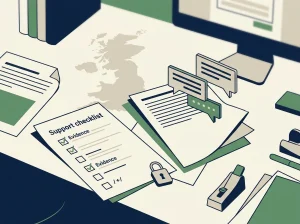


The label usually describes when checks happen, not whether identity documents can be requested before play or when you ask to withdraw.
What “No ID Verification” Means on a UK Casino Site
“No ID verification” sounds like a promise that a casino will never ask who you are. In practice, it more often describes the timing of checks. A site may let you create an account or begin registration before asking for documents, then request them later. That is deferred verification, not an exemption from it.
The distinction matters when comparing a UK-licensed casino with a site operating from overseas. UK-licensed casinos almost always verify customers at some stage, and many complete full KYC checks before accepting a first deposit. KYC means “know your customer”: the operator checks details such as your identity before allowing account activity to proceed. The exact point at which the request appears can differ, but “no ID” should not be read as “no checks”.
Offshore sites often use a different sequence. They may allow a deposit and play before requesting identity documents, with checks commonly arriving when you ask to withdraw. That can make the account feel verification-free at first, yet the apparent difference is about when the operator asks, not whether it may ask. A pending cashout can therefore be the first moment a player discovers that documents are needed.
A useful comparison is to separate three stages: opening an account, depositing and playing, and withdrawing. A casino’s wording may describe only the first stage. It does not tell you whether verification will be required before a later stage, nor does an early deposit prove that the account has passed every check. Read “no ID” as a claim about the sign-up experience unless the operator’s terms clearly say otherwise—and treat that claim cautiously.
Online Casino No Registration in the UK: Explained
For a UK player, the phrase “casino no ID verification UK” is therefore misleading if taken literally. It does not identify a category of casino that is free from identity checks. It points instead to a possible difference in timing: UK-licensed sites often ask earlier, while offshore casinos may postpone the request until cashout. Neither timing guarantees that a withdrawal will be immediate or document-free.
Before choosing a site, look for the point at which its terms allow identity checks and whether those checks can affect withdrawals. Compare that policy with your own priority. If you want fewer surprises before depositing, earlier KYC may be clearer. If a site delays checks, that may feel simpler at registration, but it leaves an unresolved step for later. Different timing, same practical question: when will you be asked to prove your identity?
Top online casinos in the UK
- WinBeastBonus: €5000 + 500 FS + €650 Freebet · Payout speed: 1-3 business days
- AmunbetBonus: Join now and get 450% up to 2,700 GBP + 450 FS · Payout speed: 1-3 business days
- ZombillionBonus: Welcome Pack 250% up to £4000 + 200 FS · Payout speed: 1-3 business days
- DieselwinBonus: Welcome Pack 250% up to £4000 + 200 FS · Payout speed: 1-3 business days
- NightWinBonus: £900 + 400 free spins · Payout speed: 1-3 business days
- SlotoSportBonus: 500% up to £ 10 200+ 777 FS · Payout speed: 1-3 business days
Online Casinos: Checks Before Play or at Cashout?
The key distinction is when a site checks your identity, not whether it checks at all. For online gambling in Great Britain, the rule is clear: a gambling business must verify your age and identity before you gamble. A site that lets you register or browse games before completing checks is not necessarily offering a way to play real money without verification.
Before play: the UK-licensed process
UK-licensed casinos commonly complete their checks before you can make your first deposit. That means you may be asked to confirm who you are while setting up your account, rather than reaching the games immediately. The aim is to establish your age and identity before gambling begins.
This can feel like an extra step, particularly if you expected to deposit first and sort out account checks later. But timing matters: a site that completes verification early gives you a clearer indication of whether you can use the account before you put money into it. A request for checks is not, by itself, evidence that something has gone wrong.
If a site advertises an online casino with no ID needed in the UK, read the claim as a timing promise to question, not as proof that identity checks do not apply. “No ID” may describe a registration experience or a delay before a request appears. It does not change the requirement for age and identity verification before gambling in Great Britain.
At cashout: checks delayed, not removed
Some sites allow registration and activity to proceed before asking for full identity checks. In that pattern, a request may arrive when you try to withdraw. This is the timing difference behind many claims about casinos with no ID verification: checks can be postponed until a later stage, rather than absent.
Attention: A successful sign-up, deposit, or gaming session does not confirm that further identity checks will not be required later.
That distinction can affect your experience. If you discover a verification requirement only after playing, you may have to pause while the operator reviews your account. You should not treat a successful sign-up, deposit or gaming session as confirmation that no further checks will be required. The point at which a site asks for information can differ; the existence of a check cannot safely be ruled out from the wording of an advert.
A site that delays verification until cashout may therefore seem less demanding at the beginning, but that is not automatically better for you. The comparison depends on your priority. If you want to know where you stand before depositing, checks before play offer greater clarity. If you are considering a site that postpones checks, assume that you may be asked to complete them later and assess the terms before using the account.
What “no photo ID” does—and does not—tell you
A claim about not needing photo ID is narrower than a claim that no identity check will ever happen. The wording may refer to what is requested at one point in the process, but it cannot establish that the operator will never ask you to verify your identity. Nor does the phrase “no ID required” override the requirement to verify age and identity before gambling in Great Britain.
Look for the practical distinction between account access and permission to gamble. Being able to open a page, register, or see games does not necessarily mean you have completed the checks needed to play. Likewise, being allowed to begin an account process does not guarantee that you can later withdraw without further review.
A useful comparison
| Timing | What it means for you |
|---|---|
| Checks before play | Age and identity are checked before gambling begins; you have more clarity before depositing. |
| Checks delayed until cashout | The account may appear usable earlier, but a later request can interrupt access to your funds. |
| “No ID” claim with no clear timing | The phrase alone does not tell you whether or when verification will be required. |
For any real-money online casino, judge the process by the stated timing of checks, not by a broad “no ID” label. In Great Britain, age and identity must be verified before you gamble. The apparent advantage of a delayed check is simply that it happens later. That is a timing difference, not a verification exemption.
Offshore and Non-GamStop Casinos: Licensing, Scope and Limits
“Non-GamStop” describes a site’s connection to the UK self-exclusion scheme, not a separate category of UK licence. These casinos do not hold a UK Gambling Commission licence, so they are not integrated with GamStop. By contrast, UK-licensed operators must take part in the scheme.
Casinos Not on GamStop with Instant Withdrawals
That distinction matters if you have self-excluded. GamStop applies at UK-licensed casinos; an overseas site outside the scheme will not be covered by that exclusion. This is a difference in regulatory arrangements, not a reason to treat non-GamStop sites as a way around a restriction you chose to place on your gambling.
| Point to compare | UKGC-licensed casino | Non-GamStop casino |
|---|---|---|
| UK Gambling Commission licence | Holds one | Does not hold one |
| GamStop connection | Must integrate with the scheme | Has no obligation to integrate |
| Position when serving the British market | A UK licence is required | An overseas licence alone does not authorise the operator to target the UK market |
| Identity checks at cashout | Requirements depend on the operator and when checks are completed | Identity documents are still commonly requested before a withdrawal is approved |
The key distinction is between an operator’s location and the market it serves. A casino can hold a licence from a regulator outside the UK, but that foreign licence is not a substitute for a UK Gambling Commission licence when the operator is selling gambling to customers in Great Britain. Remote operators serving the British market must hold the relevant UK licence, wherever they are based.
UK residents may play at an overseas-licensed casino where the operator is not illegally targeting the UK market. That qualification is important: being able to open a website, create an account or make a payment does not establish that the operator is authorised to serve British customers. Nor does an overseas licence make a site UK-regulated. These are separate questions.
If you are comparing a UKGC casino with a non-GamStop casino, the clearest criterion is the regulatory framework, not the marketing label. The UK licence brings the operator within the UK system, including the requirement to participate in GamStop. An overseas licence belongs to another regulator and does not provide that UK oversight. Check the operator’s claimed licence against the issuing regulator’s public register before depositing; a badge or statement on the casino’s own page is not the same thing as confirmation from the regulator.
Licensing Risk
An overseas licence is not a substitute for a UK Gambling Commission licence when an operator targets the UK market.
“No ID” does not mean no documents
Some non-GamStop casinos promote themselves as no-KYC or as sites with minimal checks. Read those claims narrowly. Most still ask for identity documents before approving a withdrawal. The practical difference may be when the casino asks for documents, not whether it can ask for them at all.
That matters if you are looking specifically for a no-ID casino site or expect to withdraw without supplying proof of identity. An overseas licence does not guarantee document-free cashouts, and the absence of a GamStop connection says nothing about a casino’s identity-check process. A claim about registration should not be mistaken for a promise about withdrawals.
This comparison also rules out an easy “best” choice. If your priority is participation in GamStop and UK regulation, the relevant criterion is a UK Gambling Commission licence. If you are assessing an overseas operator, its foreign licence and its status in relation to the British market need to be considered separately. The right comparison depends on what you need; the labels alone do not settle either question.
Treat a non-GamStop casino’s licensing status, UK market position and identity-check policy as three distinct points. Confirm who regulates it, whether it is authorised to serve the British market, and what documents it may require before releasing funds. No shortcut in the name.
Do
- Confirm who regulates the operator
- Verify if they are authorised for the British market
- Check required documents for fund release
Don’t
- Trust marketing labels alone
- Assume a non-GamStop status implies no KYC
- Mistake registration claims for withdrawal promises
How No-ID Checks Can Still Happen
A casino that advertises limited checks at registration may still verify you later. “No ID” can describe what happens at sign-up, not a promise that your identity will never be checked. Some offshore casinos use electronic know-your-customer checks (eKYC) to assess details automatically, even when they do not ask you to complete full KYC as soon as you open an account.
An automated check may be one part of the process rather than the end of it. If the information available to the operator does not settle a point, or it needs further evidence, you may be asked to provide details or documents. The precise steps depend on the casino and the information it seeks to confirm. A quick registration, then, is not the same as a check-free account.
A specialist review describes possible requests at no-KYC casinos as covering identity, address, contact details and source of funds. In practice, that means a request could concern who you are, where you live, how the operator can contact you, or where gambling funds came from. Not every account will face the same request, and the label “no-KYC” does not tell you which checks a particular operator may apply.
Before registering, read the operator’s verification terms and note what evidence it may request, when it can ask for it and how it wants documents submitted. Check that the account details you enter are accurate and consistent; discrepancies can lead to follow-up questions. If a request arrives, use the operator’s stated process and avoid sending sensitive information through an unverified channel.
The useful comparison is not simply “checks” versus “no checks”. It is what information may be checked, whether the process is automated, and whether extra evidence can still be requested. A low-friction sign-up can be real. A permanent exemption is a different claim.
Playing Slots for Real Money Without Skipping Verification
A slot game cannot make an online casino’s identity checks optional. If you are looking for real-money slots in the UK that let you play without proving who you are, separate the game from the site operating it: the operator’s obligations apply whether you choose a slot, a table game or another form of online gambling.
In Great Britain, an online gambling business must verify your age and identity before you gamble. That applies to real-money slot play, not merely to cashing out a win. A site cannot remove that requirement by labelling its slots “no ID”, “no verification” or “no KYC”. Those phrases describe a claim about the operator’s process, not a special category of slot with different rules.
In Great Britain, an online gambling business must verify your age and identity before you gamble, regardless of whether you choose slots or table games.
The game does not determine the check
When comparing real-money slot sites, the relevant distinction is the operator’s status and process, not a game’s title or theme. A slot does not verify your identity, and selecting a different one does not change what the business must establish before allowing you to gamble.
This is why “slots with no ID” can be a misleading description. It may suggest that you can deposit and play for cash without identity checks, when the legal requirement in Great Britain is that age and identity are verified before gambling begins. A promise attached to an individual game does not override the operator’s duty.
| What you are comparing | What it tells you |
|---|---|
| The slot itself | Which game you are choosing, not whether the operator can skip required checks |
| The operator’s verification process | How it handles the checks it must complete before you gamble |
| A “no ID” claim | A marketing description that does not create an exemption |
There is no useful “best no-ID slot” category for real-money play. If “best” means a slot that lets you avoid required verification, no game can meet that criterion lawfully in Great Britain. If you mean the best fit for your preferences, compare the games on the features you care about—but treat identity verification as a separate requirement, not a game feature.
Real money and free play are different
Free play and real-money gambling should not be treated as interchangeable. A free-play version is not a way to place real-money bets without the operator’s checks. Once you move to gambling with money, the age-and-identity requirement applies before you play.
Likewise, a no-deposit label does not change the distinction. Whether a slot is presented as a free version or alongside a promotion, the promotion does not create an exception for real-money gambling. The relevant point is what you are doing: playing for fun without staking money is different from gambling with money on the site. Do not read a “no deposit” or “no ID” claim as permission to begin real-money play before the required verification.
A practical way to assess a claim
Use a simple test when a site presents its slots as available without ID:
- Is the offer for free play, or does it involve real-money gambling?
- Does the claim refer to the slot, or to the operator’s identity checks?
- Does it imply that you can gamble for money before your age and identity have been verified?
If the claim promises real-money play with no verification, it conflicts with the requirement for online gambling businesses in Great Britain. That remains true even if registration looks brief or the slot opens quickly. Access to a game is not proof that the operator has met its obligations.
The clearest comparison is therefore not “which slot needs the least ID?” It is whether the site’s real-money play is being offered under a process that verifies age and identity before gambling. You can choose a slot according to your own preferences, but no real-money slot should be treated as a route around that check. The game is not the loophole.
Crypto and Other Casino Games: What “No ID Required” Leaves Out
Paying with Bitcoin or Ethereum changes how money moves; it does not switch off identity checks. A crypto casino may let you deposit from a digital wallet, but the payment method does not prove your age or establish who controls the account. For online gambling in Great Britain, the operator must verify your age and identity before you gamble. “No ID required” is therefore not a reliable promise that you can play real money games without checks.
Crypto and Identity
Using Bitcoin or Ethereum changes the payment route but does not prove your age or identity. For UK gambling, operators must still verify your identity before you gamble, meaning crypto is not an identity-free pass.
The same distinction applies whether you choose roulette, blackjack or another casino game. The game does not determine whether verification applies, and a cryptocurrency deposit does not create an exception. Some operators may ask for information or documents later in the account process, including when you seek a withdrawal. The practical comparison is not simply “crypto versus card”; it is what the operator checks, when it checks, and whether the payment route suits you.
Crypto can affect withdrawal speed, but it cannot guarantee it. Specialist reviews have reported that some operators accepting cryptocurrency can process withdrawals in minutes. A separate specialist review has described cryptocurrency withdrawals at serious offshore operators as taking one to six hours. These are reported processing times, not a promise for your account: verification, operator handling and the cryptocurrency network can all affect when funds arrive. Fast transfer is not the same as immediate approval.
That distinction matters when comparing a crypto casino with a site using another payment method. A quick transaction after approval tells you little about how long the operator may take to review an account or release a withdrawal. Check the casino’s identity-check policy and withdrawal terms before depositing, rather than treating crypto as a route around them. If the operator asks for documents, using a wallet does not remove that request.
There is also a regulatory question separate from payment speed. A site accepting Bitcoin is not, for that reason, authorised to serve customers in Great Britain. Remote operators selling into the British market need the relevant UK Gambling Commission licence. Crypto does not change the operator’s licensing position or the rules that apply to gambling.
Non-UK Licensed Casinos: UK Rules and Protections
So, if you are comparing games and payment options, use two separate criteria: whether the operator is properly licensed for the British market, and what its payment and verification terms say. Crypto may offer a different route for deposits or withdrawals, and some reported processing can be quick. It is not an identity-free pass. The label is doing too much work.
Withdrawals: Verification, Approval and Payment Time
A withdrawal has two separate stages: the casino must approve the request, then the payment must be settled. These stages are easy to confuse when a balance remains unavailable after you ask to cash out. The first delay is at the operator’s end; the second concerns the route by which approved funds are paid.
Approval is not the same as a payment being on its way. A casino may still need to complete its checks before authorising a withdrawal, even if registration and play appeared straightforward. In particular, offshore casinos typically require identity verification before processing a first withdrawal. “No ID” in a site’s marketing therefore cannot be treated as a promise that you can withdraw without checks.
When comparing withdrawal terms, look for what the operator says about both stages. Does it explain what can hold up approval? Does it state how payments are handled after approval? If the terms describe only a general processing period, that may not tell you how long the full wait will be: the operator’s review and the payment settlement are different parts of the process. Clear wording matters more than a headline claim about fast cashouts.
Withdrawal Process
Stage 1: Approval
The casino reviews the request and completes any necessary identity checks to authorise the cashout.
Stage 2: Settlement
Once approved, the funds are processed through the chosen payment route to reach your account.
A further issue is how much you can withdraw over a stated period. A specialist review reports that offshore casinos may set monthly withdrawal caps. Where a cap applies, a large win may have to be paid out in portions rather than all at once, delaying access to the full balance. The cap and its scope are operator-specific, so check the relevant withdrawal terms rather than assuming that one site’s rules apply elsewhere.
A useful comparison is therefore not simply “which casino pays fastest?” Separate the criteria: verification requirements, the casino’s approval process, payment settlement, and any withdrawal cap. The right choice depends on what matters to you. A shorter stated payment time is of limited use if approval is still pending or a cap restricts how much can be released.
Before depositing, read the withdrawal conditions and check whether the operator explains its identity checks and payout rules in plain language. If the rules are difficult to find, unclear, or inconsistent, that is a practical warning sign—not evidence that checks will be skipped. Keep the advertised payment speed separate from any claim about verification, and do not assume that a displayed balance is already approved for payment.
For a real-money casino serving customers in Great Britain, the legal standard is also relevant: the UK Gambling Commission requires age and identity checks before a customer gambles. Offshore sites sit outside that UK licensing system, and their withdrawal arrangements may differ. That does not turn delayed checks into absent checks, nor does a quick advertised cashout settle the question of what documents may be required.
Non-UK-Regulated Casinos: UK Rules and Licensing
The comparison is simple, if not especially glamorous: approval first, settlement second. Read both parts before you play.
No-Deposit Bonuses, Crypto Deposits and the Terms to Check
A no-deposit offer can sound like a way to try a casino without paying in, while a crypto option may seem like a separate route around ordinary payment checks. Neither assumption tells you what the offer permits. A promotion does not guarantee that you can withdraw winnings without meeting its terms, and paying with cryptocurrency does not remove identity checks.
Before accepting a bonus, read the conditions attached to it rather than relying on the headline. Check which games count, whether winnings are capped, what wagering requirements apply and whether a deposit is needed before withdrawal. Also look for rules that can cancel the offer, such as excluded games or payment methods. A “no deposit” label describes the entry point, not necessarily the route from bonus balance to withdrawable money. Terms matter more.
The same distinction applies when cryptocurrency is offered. A crypto deposit may be accepted by an operator, but it does not make the account anonymous to the casino or make a promotion condition-free. Check whether the bonus is available to crypto users at all: some offers exclude particular payment methods, and using an excluded method can affect eligibility. Do not deposit first and assume the offer will attach afterwards.
Bonus and Payment Check
- Read the full terms and conditions of the bonus
- Verify if the bonus is available for your chosen payment method
- Check for any excluded games or wagering requirements
- Confirm if your bank allows transactions to the operator
Check the cost and whether the payment goes through
A crypto option is not the only payment consideration. British banks may decline, flag, delay or block transactions to offshore gambling operators. A specialist review has reported that some UK banks block such transactions by default; bank policies can change, so check with your provider rather than treating that account as a universal rule.
Credit cards are another point to examine. UK-licensed casinos cannot accept credit-card gambling deposits, while offshore platforms may accept Visa or Mastercard. A specialist review reports offshore casino credit-card deposit fees in the 2% to 5% range. Treat that as a reported charge, not a guaranteed tariff: check the payment screen and the operator’s terms before confirming a transaction. A card payment that is declined or charged a fee can change the real cost of an offer.
For a crypto-related bonus, verify the accepted currency, the offer’s eligibility rules and any fees or conversion terms displayed before you pay. Then compare the promotion’s conditions with the payment method you intend to use. If the terms are unclear, the headline is not a substitute for an answer. No free money.
Free Spins Do Not Remove the Verification Requirement
Free spins can change how a slot session is funded, but they do not change the checks that apply before you play. An online gambling business serving customers in Great Britain must establish that you are old enough to gamble and confirm your identity before you place a bet. A promotion is not an exception.
That matters when an offer is described as free spins with no ID verification. The phrase may suggest that you can claim and use spins without providing details, but the offer cannot remove the operator’s duty to check who is playing. If those checks have not been completed, the spins do not provide a legitimate route to start gambling first and verify later.
Non-GamStop European Casinos: A UK Guide
Before accepting an offer, read its terms alongside the casino’s account requirements. Look for when the operator asks you to confirm your age and identity, and whether you must complete that process before accessing the promotion. If the wording implies that free spins let you gamble without those checks, treat the claim with caution.
The useful comparison is not simply how many spins an offer advertises. Check whether its conditions are clear and whether the verification requirement is explained before you register or try to use it. The promotion may be free; the checks are not optional.
Paying by Mobile: Deposits Are Not Withdrawals
Paying through your mobile phone can make a deposit straightforward, but it does not provide a route for taking winnings back out. A specialist review reports that Boku and similar mobile-payment options at offshore casinos are deposit-only. Treat the method as a way to fund an account, not as a complete payment plan.
Before depositing, check the cashier’s withdrawal options and whether the casino requires withdrawals to use a payment method in your own name. If mobile billing is the only method you see at the deposit stage, that does not tell you how a withdrawal will be paid. You may need to select another available method, and the operator may ask you to complete its checks before approving a cashout.
The “no ID verification” label does not change this distinction. A mobile payment does not remove identity checks, and it does not promise that you can withdraw without providing documents. Boku is a payment option, not a verification exemption.
Compare methods by two separate criteria: whether they accept deposits and whether they support withdrawals. A deposit method that cannot receive payouts may still be usable, but only if you understand the separate cashout route before sending money. If the withdrawal method or its conditions are unclear, pause rather than assuming your phone bill or mobile account will receive winnings.
The practical test is simple: identify the withdrawal route first, then decide whether the deposit method suits you. Mobile payment can get money in. It does not bring it back.
Do UK banks block deposits to non-GamStop casinos?
Yes, some UK banks may decline, flag, delay or block payments to offshore gambling sites.
Is it legal for UK players to use non-UK-registered casinos?
Yes, UK residents can legally play at casinos licensed outside the UK, provided the operator is not illegally targeting the UK market.
Do non-UK-registered casinos accept credit cards?
Yes, offshore casinos routinely accept Visa and Mastercard, although deposits commonly incur fees of 2% to 5%.
Material created by the team Jackpot City UK Guide